I'd like to dedicate this blog post to Carolyn Foley of
caro-rose creations.
Carolyn blogs daily and her posts are always worth reading, be they about her cute grandchildren, art of the world, Australian life or, of course, textile. She is a teacher, not only to her students but to us all, and she has some great tutorials on her blog.
Now I don't know anyone who is as good at digging up information as Carolyn.
In December last year she had on her blog a series of angels, one for each day of Advent. On Dec 4th she showed an especially beautifully embroidered angel. It was from the
Lyng altar cloth.
Lyng is a small village in Norfolk, UK. Every summer I visit Norfolk and immediately thought I'd try to go and look at the altar cloth during my stay this year.
So a few weeks ago, together with friends, I went in search of St Margaret's of Lyng. The church is lodged in between the village pub and some of the cottages and not that easy to find access to. Like so many of the numerous old churches in East Anglia it is an important symbol of the village but in need of funds and a lot of Tender Loving Care.
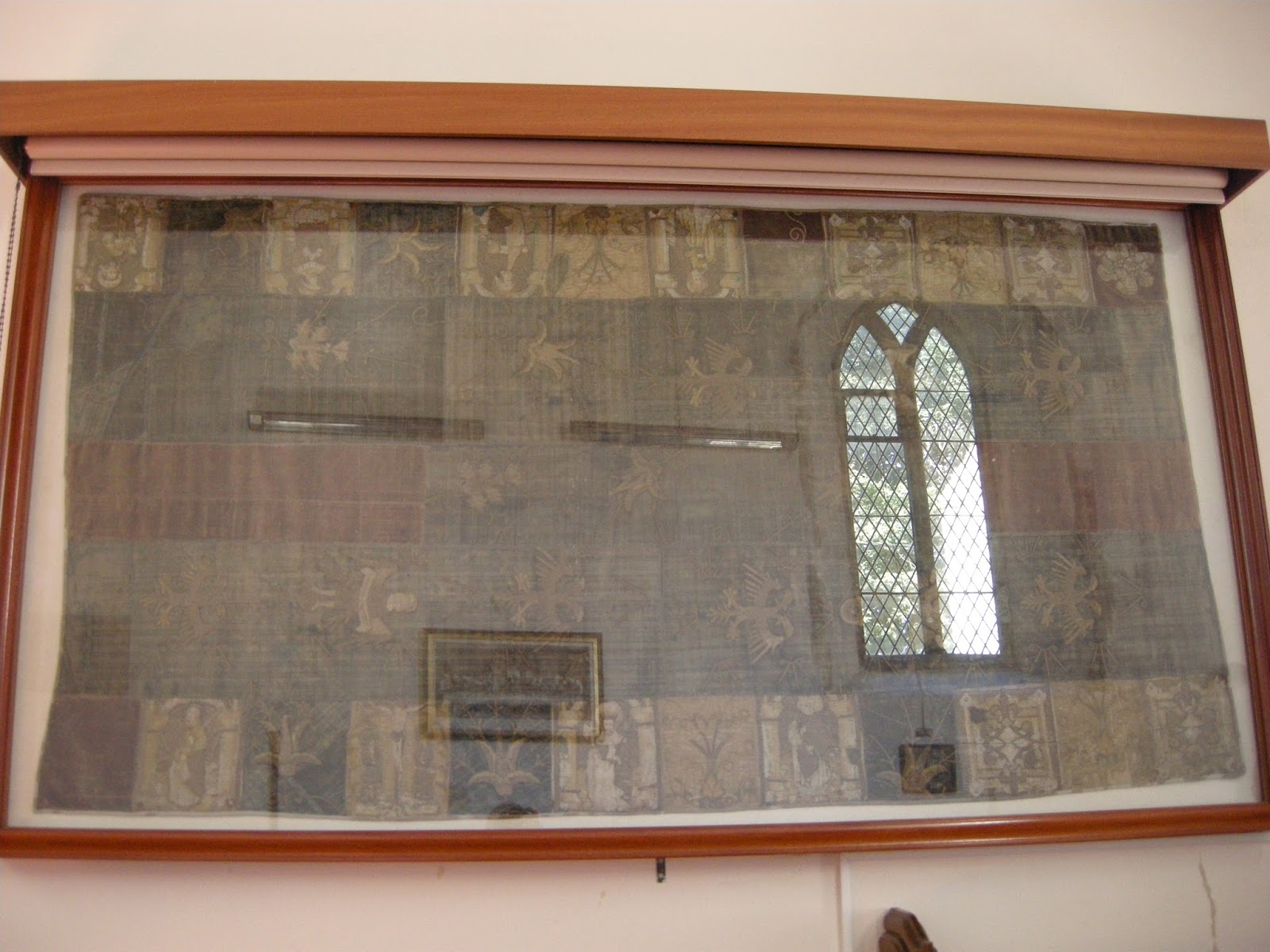
To our delight we found the old altar cloth that is displayed in a glass case on the wall. So why is it not in use?
It is a 'patchwork', made up of several old vestments.
It seems likely that the church was completed in the early 1300 and the vestments might have been presented to the church at some time.
According to Patricia Hallert's pamphlet 'LYNG ALTAR CLOTH', '
Between 1558 and 1678 during the Protestant reigns of Edvard VI and Elizabeth I, many parish churches cut up their vestments to make them into frontals or cloths for the Communion table. Lyng cloth is cleverly constructed from three different vestments, all dating from the 15th century and of English workmanship. From 1678 onwards Lyng church terriers record an 'ancient carpet for the Communion table', which was the altar cloth.'
Furthermore, Ms Hallert notes in her pamphlet that there is a record of 1933 of the cloth being framed and hung.
In 1985 the altar cloth underwent restoration at the Textile Conservation Centre by Wendy Toulson and has thereafter hung in its glass case on the south wall of the chancel.
As you can see, the reflections in the glass make it hard to see the beauty of the embroiery.
For better pictures and more facts, please go to the link that Carolyn has on her blog,
Medieval Church Art.
However, there were other textile delights in the church. Look at the charming kneelers.
Carolyn, thank you for always giving us so much information, and inspiration to go textile trekking. Please keep up the good work!