Showing posts with label Japanese Darning Stitch. Show all posts

Sunday, 5 February 2017

Sunday Stitch School - Revision: Stitches 6 - 10

The last six lessons of Sunday Stitch School have taught me these stitches: Four Sided, Gate, Heavy Chain, Interlaced Running and Japanese Darning.

Here is a summery of my impressions.

Four Sided Stitch
It is easy and rhythmical. Each square could be used to frame crosses, knots, beads or sequins. Apart from that it is obviously great for filling empty spaces.


 Gate Stitch
A descriptive name for this stitch which indeed looks like a gate. It makes a compact filling stitch but also gives you a proper gate in a fence.


Heavy Chain Stitch
Oh, this fun and easy to work stitch leaves a rich cordlike line and can be a good replacement when you want something more dominant than a stem stitch. It 'writes' well and is perfect for monogramming or handwriting.


Interlaced Running Stitch
My box of fancy threads asked to be opened and out came cries of 'Use ME' and 'I want to LACE those Running stitches'. It was so much fun playing around with them all. There is no end to how this stitch can be spaced, curved and laced.


Japanese Darning Stitch
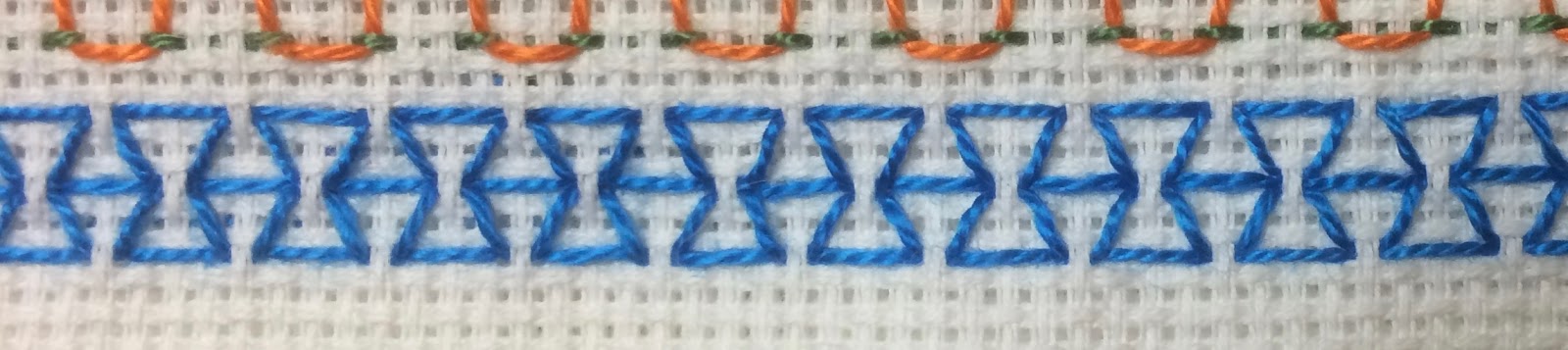
Worked row upon row it makes a  neat filling stitch, while in two rows it forms a unique ornamental border. As far as I can see it has no connection to Japanese embroidery.


Revision Homework:
Use the five stitches on this modern design of Sunbonnet Sue.

Friday, 3 February 2017

Friday Homework for Lesson 10: Japanese Darning Stitch

Way in the past, when I saw the Japanese Darning Stitch in books, I thought it must be an easy stitch. After giving it a half hearted try once, it turned out all wrong and I abandoned my attempt. That is why I choose this stitch for Sunday Stitch School's tenth lesson. I  HAD  to master it.

Once I got the hang of the spacing, it was easy-peasy and most enjoyable. I think it would indeed be a decorative darning stitch and fun to add to a Crazy Quilt seam, maybe with other stitches added.

I wanted to explore more, but did not find the time, so here is the set homework :

Chitra of Jizee6687's weblog has some stunning ways of working the Japanese Darning Stitch. Check them out here.

Sunday, 29 January 2017

Sunday Stitch School - Lesson 10: Japanese Darning Stitch

Darning socks, clothes and other textile items was seen as a necessary skill in the past, and samplers were made to show how.
The Japanese stitching crafts of sashiko and kogin were used to reinforce clothing, joining layers together and at the same time embellish what needed to be mended or strengthened. Intricate patterns were created and handed down.
However, the embroidery stitch known as Japanese Darning is a combination of the Running Stitch and the Holbein Stitch and does not feature in the Sashiko or Kogin style.
Or am I wrong? Carorose, Queen of Kogin, is there a connection? Do you know the history of Japanese Darning?

Mattia supplied the French name: Point de trait japonais ou point de reprise japonais, but I have traced no name in Swedish, nor in JAPANESE!!!!!

I found the Japanese Darning Stitch in several of my books, the best illustrations were in The Embroidery Stitch Bible.


This is what Japanese Darning Stitch looks like on my Aida sampler.


Working order:
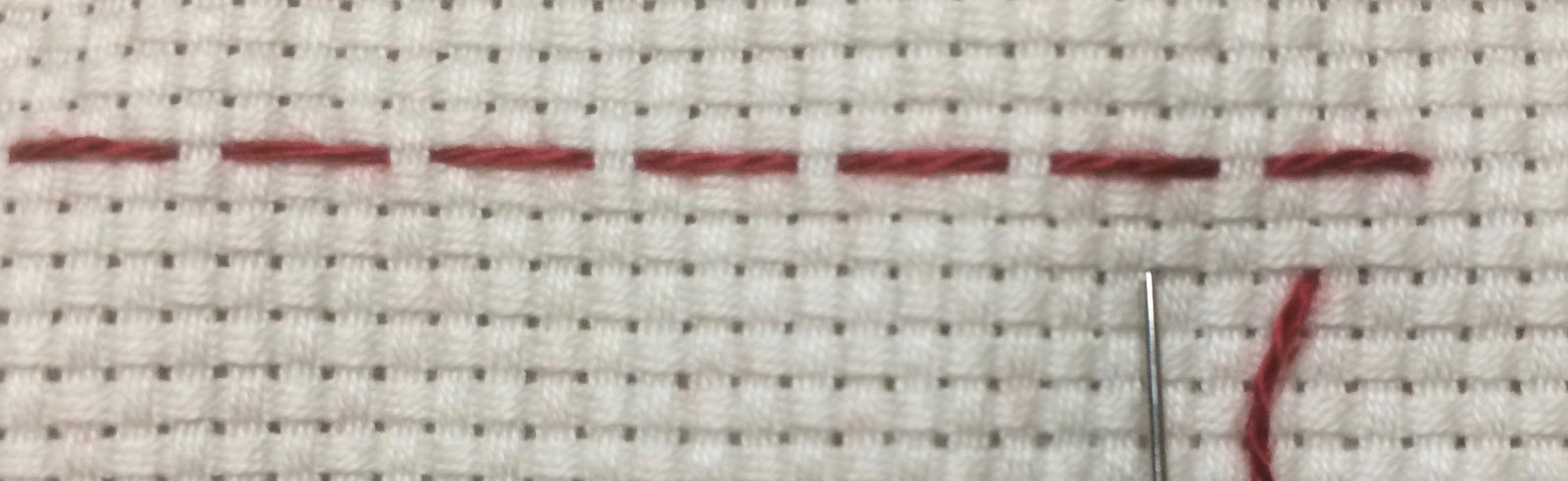
 First a row of Running Stitches, longer on the top of the fabric than below and over an odd number of holes.


Then add a second (and third and so on)  row where the stitches are placed in a brickwork fashion.

Stitch slanted Straight Stitches to join the rows.
 For clarity I have used a different colour.

 Continue in the second row.

By using two rows you get a zig-zaggy border.
By adding row upon row you can fill a larger area, and

that is the HOMEWORK:
Fill a block on this sampler with Japanese Darning.

Happy Stitch Sunday to all!