I do have a lesson and a stitch for today, but I want to give some background to it and talk about how I finally came to include this stitch. If you don't want to read my long ramblings, scroll down and you will find the instructions and step-by-step pictures below.
-o-o-o-o-o-o-
I started Sunday Stitch School in 2016. I had learned a lot of TAST (Take A Stitch Tuesday) stitches, but wanted to learn more. I had all these embroidery books, and there was the internet, and YouTube...
At the outset I had no idea how much I would learn. I am not talking about the embroidery aspect of the stitches - of course I learned how to stitch each one, unfortunately it does not mean I remember how to stitch many of them, without looking at the instructions, sigh!
No, I am referring to all that I have learned about other things, because of the stitches.
For example I have gained geographical knowledge as I looked up in an atlas, where stitches with these names come from: Anundsjö, Rumanian, Hungarian, Mountmellick, Bosnian, Parma, Smyrna, Cashmere, Kerman, Antwerp Edging, Puncetto Valsesiano, Ceylon, Croatian, Norwich...
I have learned about botany: Thorn, Rambling Rose, Moss, Leaf, Petal, Maidenhair, Chemanthy, Dandelion, Sycamore, Raised Daisy, Hyacinth...
Biology: Sprat's Head, Crow's Foot, Snail Trail...
I learned some French: Tet-de-boeuf, Mille Fleur, Point Russe, Point à la Minute...
Some stitches refer to architecture: Gate, Vault, Step, Tied Windmill, Brick...
I have also been struck by how many stitches have a name with religious references: Cross, God's Eye, Mennonite Tacks, Methodist Knot, Celestial Eyelet, Pagoda Chevron...
Today's stitch belongs to this last group.
I first saw the beautiful Catherine Wheel Stitch in Mary Thomas's Dictionary of Embroidery Stitches. Then online at StitchDoodles, where you can see clear instructions.
Catherine Wheel Stitch is made up of a combination of stitches. You start with a circle of Buttonholed Blanket Stitch, with the spikes turned outwards. Across the void circle you make up the spokes of the wheel with Straight Stitch. The very middle of them is then whipped to form the hub. The result is an elegant wheel.
I saw it, and liked it. Then, a chill went down my spine!
A bit of online research made me realise that this stitch has a gruesome meaning. A Catherine Wheel is an instrument of torture!
It got its name from the torture of Catherine of Alexandria by the Roman emperor Maxentius in the 4th century. Catherine came from a noble family, was thoroughly educated and intelligent. When she refused to denounce her Christian faith, though, she was sentenced to be executed by torture on a spiked wheel. Legend has it that the wheel broke as soon as she touched it, and Catherine was instead beheaded. She was later made a saint.
You can read about St Catherine of Alexandria here.
When I looked at the beautiful Catherine Wheel Stitch again, I realised what the Buttonhole Spikes actually were, I could almost see the drops of blood... and I didn't want to include this macabre stitch in my Sunday Stitch School collection!
So why have I change my mind and added Catherine Wheel?
It happened after I watched TV news the same day. I learned of villagers, ordinary civilians, in an African country who had been beheaded by barbaric rebels, and of a 3-year old Japanese boy who had died at the hands of his mother's cruel boyfriend...
I NEED to learn this stitch! I NEED to remember the suffering of others, I NEED to reflect on WHY humans have this urge to be cruel to others.
Torture happened in the past, it happens today, it happens in countries far away, it happens close by. Bloody assults, destroyed crops that cause starvation, discriminations against people for who they are and for their looks, their abilities, their beliefs. All over the world you have dictatorship, bullying in school, power harassment at work, backstabbing comments online, nasty gossip among neighbours... Where does it come from, this need, this urge to trample on those who are weaker?
The Catherine Wheel will help me focus on questions like these, and remind me to perform acts of kindness and help, to try to counteract the viciousness of the world.
A stitch can teach us so much, geography, botany, biology, languages, architecture, religion, history - and philosophy.
-o-o-o-o-o-o-o-o-o-o-o-
Here are my picture instructions for Catherine Wheel Stitch:
Mark two circles on the foundation fabric.
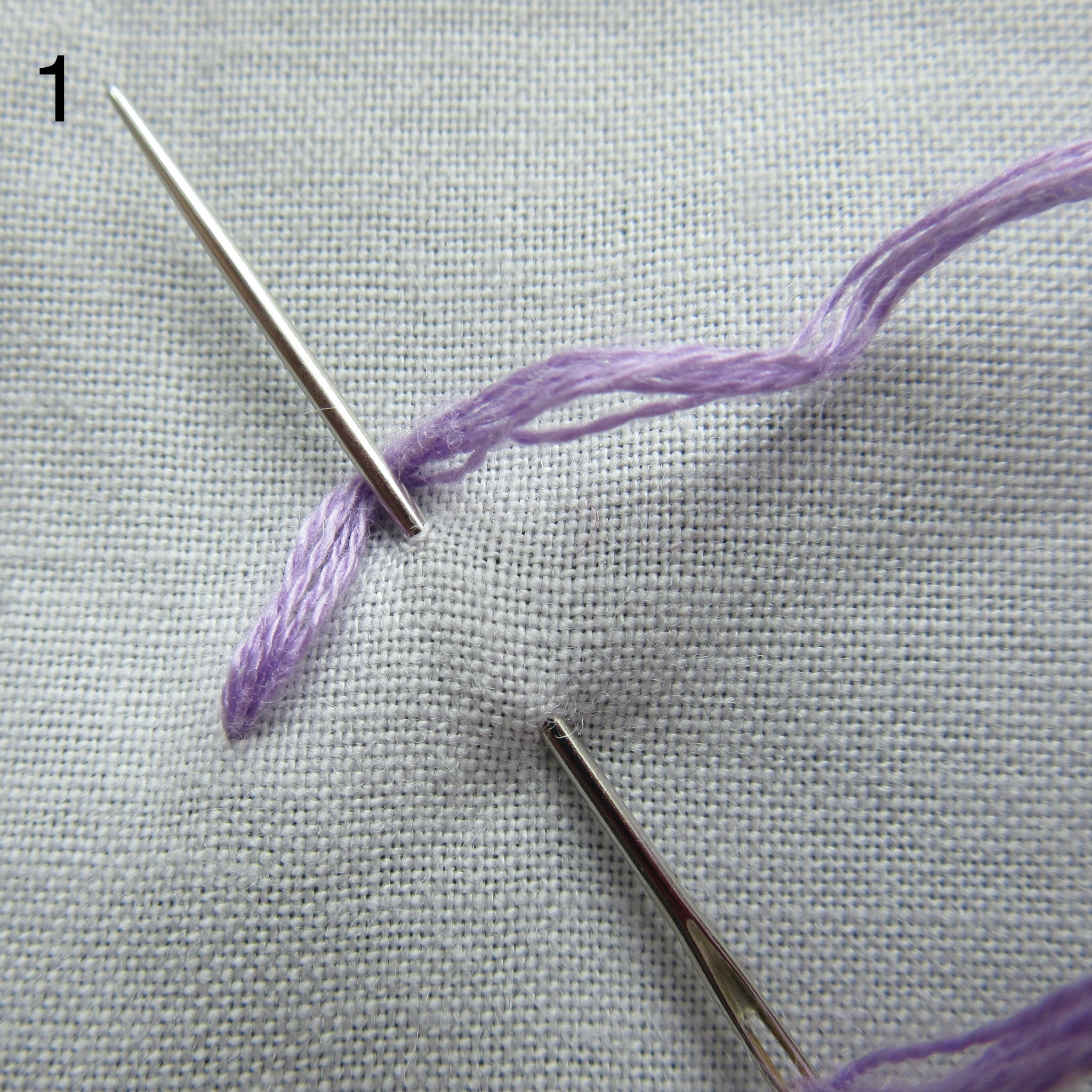
Stitch Buttohole Stitch along the lines,
make sure the spikes are turning outwards.
When you come to the end/beginning
of the circle, go upwards UNDER
the first stitch,
and anchor at the top.
Make four Straight Stitches,
across the open area of the circle.
If the stitches are long, like these, I
recommend that you anchor them
with a knot at the back.
Change to a different thread and
stitch Buttonhole Stitch over the
(purple) thread, without biting the
fabric. Work your way around the
circle.
Anchor the thread and change to
another colour, then come out
from the very centre.
Use Back Stitch over the (green)
spokes and work your way
round the circle.
Anchor the blue thread when
you have a nice hub.
Remove the marking lines.
Homework:
Add to the samplers, and reflect
on what this wheel stands for,
while you work.