Kogin embroidery is something that the city of Hirosaki and Aomori prefecture is very proud of.
Near Hirosaki station the tiles of the pedestrian area and bus terminal have been laid out in Kogin patterns. See the view from this hotel.
There is a bridge in another area of the city decorated with Kogin pattern.
However, the first view of 'real' Kogin embroidery I got on my visit was at the 'onsen' inn I stayed at. 'Onsen' is the Japanese name for a mineral hot spring. As there are so many volcanos in Japan the number of 'onsens' is great. Almost everywhere you go there will be a hot spa in the neighbourhood. Aomori has its fair share.
Around a spring there usually are a number of public bath houses, inns and hotels. Unlike Western 'spas' these are not usually health farms with fitness plans, thermal treatments or doctors. Instead you go there to relax, be spoiled with service and enjoy eating local delicacies.
I stayed at Fujiya Hotel.
Like all other hotels and inns Fujiya had a hotel shop. They sold souvenirs, locally produced sweets and pickles, and handicraft.
Here was my first glimpse of Kogin embellished items, made in Aomori:
I wanted to see more and older things so the next day I went 'Kogin hunting'.
Showing posts with label Japanese textile. Show all posts
Saturday, 7 December 2013
Sunday, 1 December 2013
Kogin 1 - Kogin Country
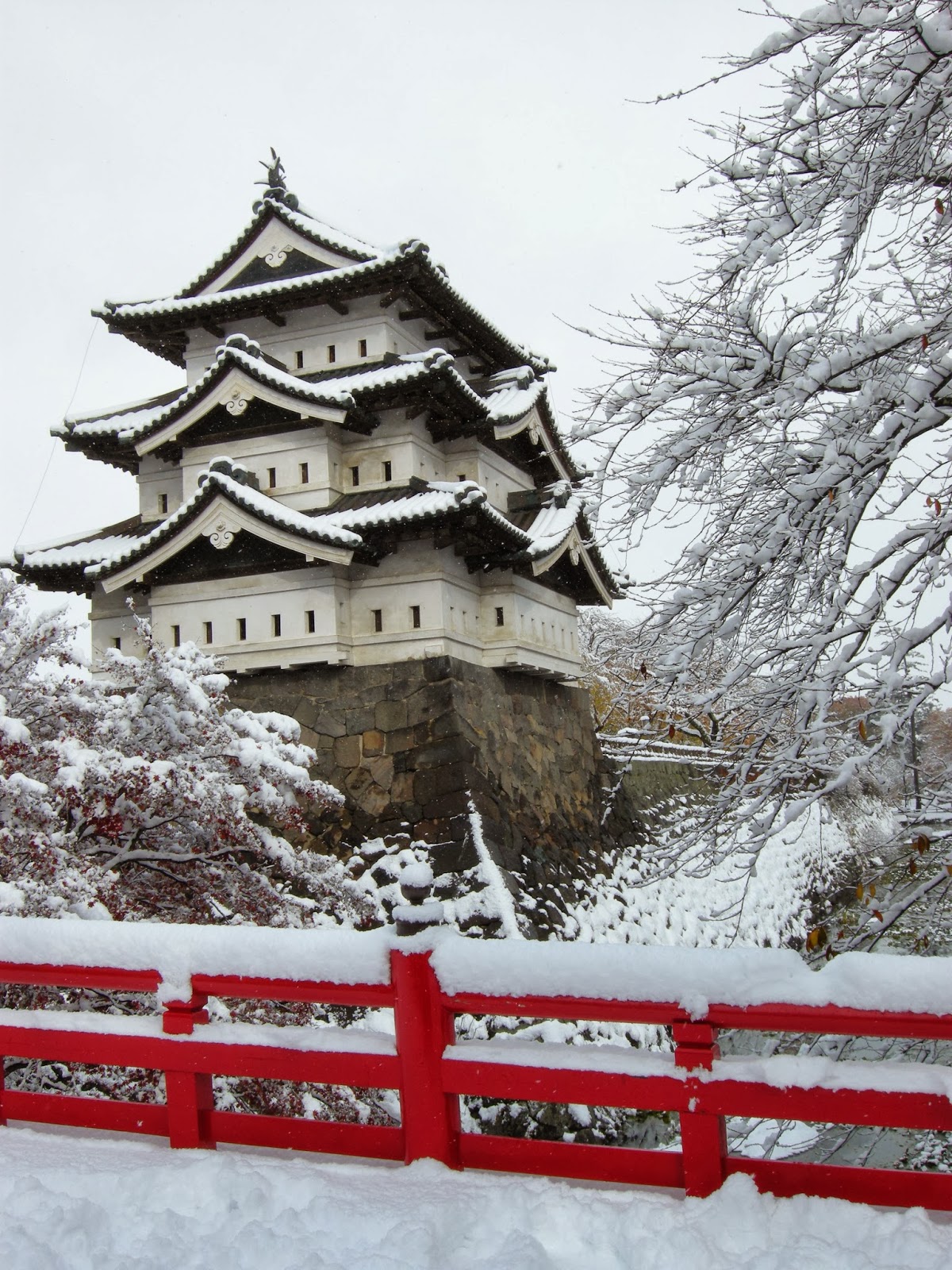
Do you remember this photo I posted some weeks ago?
Now this is a blog about needlework so I will leave the topic of tourist attractions, and talk instead of embroidery, because Hirosaki and the surrounding region, Tsugaru, is famous for Kogin embroidery.
This is a form of needle darning of fantastic geometric patterns. The stitch is simple, but the patterns complex.
Whenever I have seen Kogin embroidery, e.g. at the Amuse museum in Tokyo, or on handicraft projects I have been charmed by the designs. Whenever I have read about Kogin in books at the library or online, and there are a number of exceptional blogs (see below), I have been wanting to see and learn more.
So I went in search of Kogin on my trip to Hirosaki. I returned with reading matters, pattern, a ready stitched purse and sampler, and material to try it out for myself.
I will be blogging about my adventures with Kogin, but without any time plan or time pressure. The posts will be listed under 'Kogin' at the top of the blog.
The interest overseas for this kind of Japanese embroidery is growing and I have found several great blogs, written in English, if you would like to read more.
The Embroiderer's Guild W.A.
Japanese Textiles from a Westerner's Perspective
Emma Creations
Nuts About Needlepoint
A blogger many of my readers are already familiar with is Carolyn Foley of caro-rose-creations. Carolyn has made a fantastic job documenting hundreds of Hishizashi patterns and created several stunning projects. Read this and look at the first pattern here.
Red and white are the official colours of Japan, Hirosaki maple leaves in the snow were very red and white. Another colour combination commonly seen in Japan is, of course, blue and white. Kogin is mostly found to be white thread on dark blue fabric. The reason I selected the lighter blue fabric and white thread for sampler and the project
was this scene of Aomori's first snow
I will always see the resemblance between the snow covered rice fields and the structured stitches.
Until next Kogin post...
I took it during a trip to Hirosaki, which is in Aomori prefecture in the northern part of Japan's main island, Honshu.
Hirosaki castle park is famous for its many cherry trees, and autumn foliage, but I was lucky to see it in the first snow of the season.
The city of Hirosaki is well known for other things, too, like its summer festival 'Neputa', French food, apple pie, coffee, cocktails, three stringed shamisen...Now this is a blog about needlework so I will leave the topic of tourist attractions, and talk instead of embroidery, because Hirosaki and the surrounding region, Tsugaru, is famous for Kogin embroidery.
This is a form of needle darning of fantastic geometric patterns. The stitch is simple, but the patterns complex.
Whenever I have seen Kogin embroidery, e.g. at the Amuse museum in Tokyo, or on handicraft projects I have been charmed by the designs. Whenever I have read about Kogin in books at the library or online, and there are a number of exceptional blogs (see below), I have been wanting to see and learn more.
So I went in search of Kogin on my trip to Hirosaki. I returned with reading matters, pattern, a ready stitched purse and sampler, and material to try it out for myself.
I will be blogging about my adventures with Kogin, but without any time plan or time pressure. The posts will be listed under 'Kogin' at the top of the blog.
The interest overseas for this kind of Japanese embroidery is growing and I have found several great blogs, written in English, if you would like to read more.
The Embroiderer's Guild W.A.
Japanese Textiles from a Westerner's Perspective
Emma Creations
Nuts About Needlepoint
A blogger many of my readers are already familiar with is Carolyn Foley of caro-rose-creations. Carolyn has made a fantastic job documenting hundreds of Hishizashi patterns and created several stunning projects. Read this and look at the first pattern here.
Red and white are the official colours of Japan, Hirosaki maple leaves in the snow were very red and white. Another colour combination commonly seen in Japan is, of course, blue and white. Kogin is mostly found to be white thread on dark blue fabric. The reason I selected the lighter blue fabric and white thread for sampler and the project
was this scene of Aomori's first snow
I will always see the resemblance between the snow covered rice fields and the structured stitches.
Until next Kogin post...
Tuesday, 7 May 2013
A Change of Decoration
The Children's Day is over and all decorations related to it have been packed away. The Koinobori (Flying Carp) quilt has been replaced with a small 50x50 cm quilt I made for the Yokohama International Quilt Week's Miniature contest in 2001.
On a trip earlier that year to the island of Shikoku I had bought a small pack of fabric from the island. Some of the pieces are the very attractive Awa Shijira-ori which is woven in Tokushima prefecture. It is a kind of seer-sucker often used for summer wear and yukata.
I mixed in other Japanese fabrics, as well as a piece from a Swedish table cloth. True to form, there is (a lot of) embroidery, and in metallic thread.
The title of the quilt is Naruto-no-maki and illustrates the fantastic whirlpools in the Naruto Strait that I saw on my trip.
On a trip earlier that year to the island of Shikoku I had bought a small pack of fabric from the island. Some of the pieces are the very attractive Awa Shijira-ori which is woven in Tokushima prefecture. It is a kind of seer-sucker often used for summer wear and yukata.
I mixed in other Japanese fabrics, as well as a piece from a Swedish table cloth. True to form, there is (a lot of) embroidery, and in metallic thread.
The title of the quilt is Naruto-no-maki and illustrates the fantastic whirlpools in the Naruto Strait that I saw on my trip.
Subscribe to:
Posts (Atom)