Showing posts with label Tete-de-boeuf Stitch. Show all posts

Sunday, 7 May 2017

Sunday Stitch School - Revision: Stitches 16 - 20

We have done another set of five stitches so it is time for a revision of them here at Sunday Stitch School.

Following is a summery. Click on the headline to learn the stitch and read more.

16: Puncetto Valsesiano Stitch
Although this Italian stitch is mainly used for needle lace to decorate textile for the home or on folk costumes, I wanted to use it in embroidery.
It is simple and easy to learn, but attention must be paid on tension.

17: Q Stitch
An accidental stitch - many years ago I anchored a Lazy Daisy Stitch carelessly, and saw the letter Q staring back at me. Why not use it as a new stitch? I just had to introduce it on Sunday Stitch School.
It is simply a Detached Chain Stitch with the anchoring stitch askew.


18: Renaissance Stitch
Or should we call it Queen Stitch or Rococo Stitch or ....
This is an easy and enjoyable stitch which looks equally good as an individual stitch or when used for filling a larger area.


19: Satin Stitch Outline
Belonging to French Whitework, this stitch is great for making a solid thin line that stands up from the fabric.
Keeping the tension is the key, and I think the placement of the split in the Split Running Stitch is of importance, too, to avoid making such lumpy lines as you can see in the picture below.


20: Tete-de-boeuf Stitch
There are some questions about this stitch; how should it be worked and what should it be called.
One thing I know is that there is nothing 'beefy' about it. Instead it has a floral quality or could be used to illustrate cheering people or combined with another upside down stitch would maybe look like an ant...


Homework:
Use SSS stitches 16 - 20 on a Sunbonnet Sue design. This time let Sue go to Sweden. 
Change the thread to something more suitable for the Puncetto Valsesiano and Satin Stitch Outline, it you feel more comfortable with another type.
Try to complete it by next Friday. If not, you can have an extra week as the two stitches above are time consuming.


Friday, 5 May 2017

Friday Homework for Lesson 20: Tete-de-boeuf Stitch

Although it is May 5th and Kodomo No Hi (Children's day) in Japan, which is a national holiday, it IS Friday, and I will hand in my homework for Sunday Stitch School.

Tete-de-boeuf Stitch has turned out to be a very controversial stitch.

First of all, the name.  Boeuf is French for beef, not bull, so the translation ought to be Beef Head Stitch rather than Bull's Head Stitch. I have got comments wondering if the blog post was about cooking.

Secondly, all my embroidery books call this stitch Tete-de-boeuf and have the instructions I showed in last Sunday's lesson.
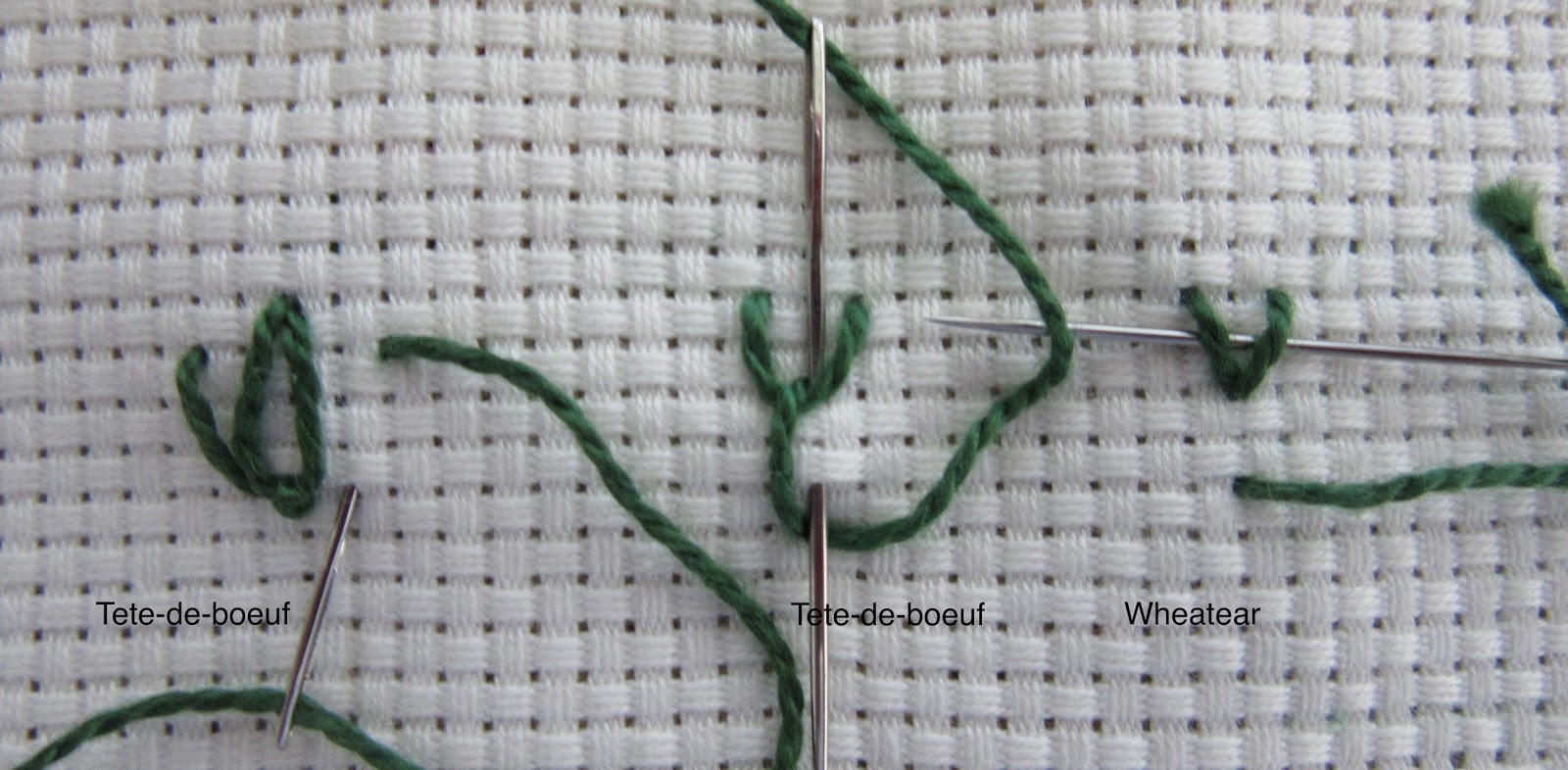
Online, however, I have found several references to this stitch worked in a different way, a way similar to, but not exactly,  Wheatear Stitch.

Have a look at this:
On the left, my instructions,
in the middle, the online instructions,
on the right, the real Wheatear.
 
The online version does resemble a bull's head with the two horns.
None of them look like a beef head, though, ; ).

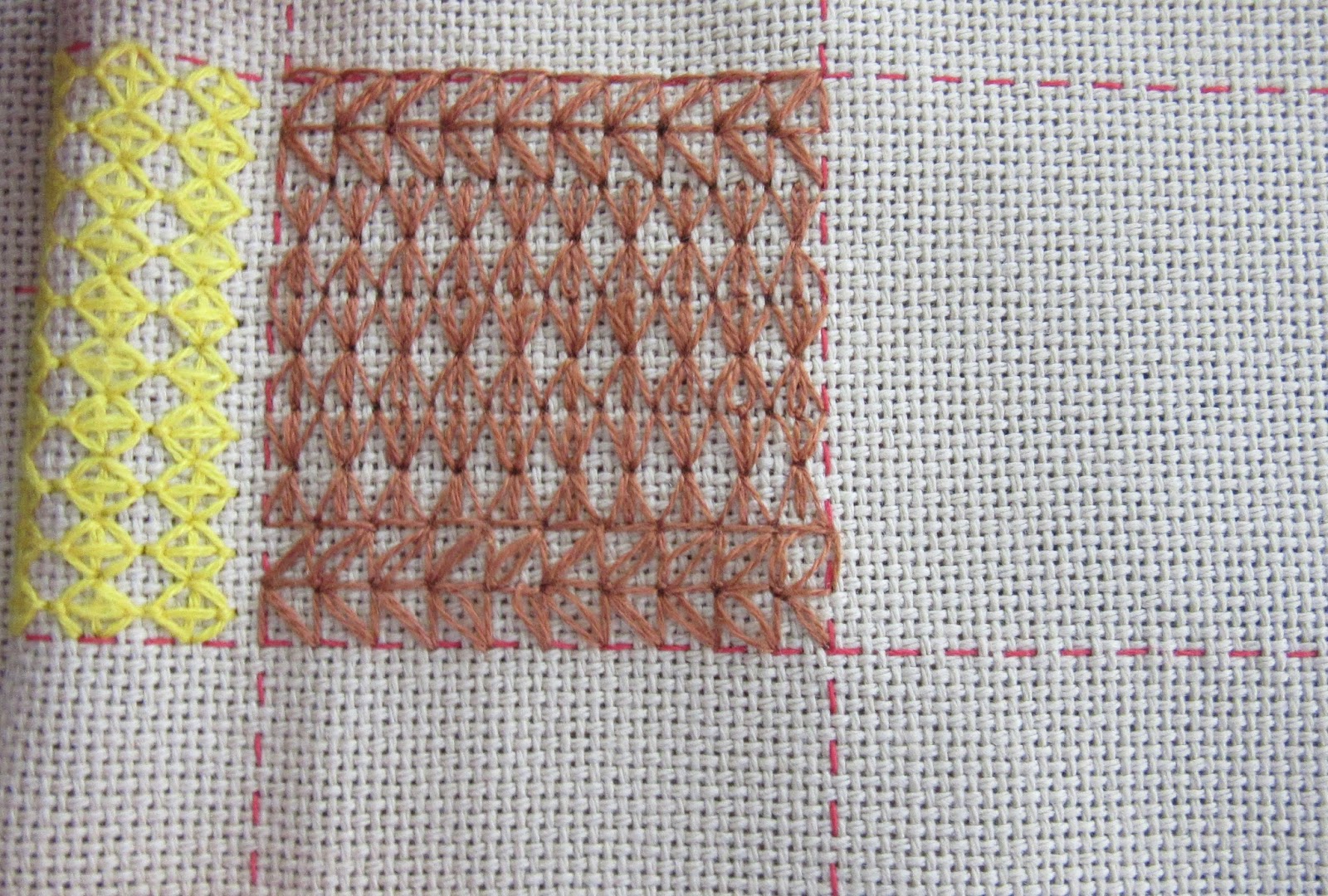
For my homework I filled in this square with Tete-de-boeuf Stitch placed in various ways.

Finally I want to show how one of the stitches once was used to celebrate children in Japan - the carps in this set of carp-streamers are worked in Wheatear Stitch. I made this card for TAST 2012, when the stitch of the week was Wheatear.


Sunday, 30 April 2017

Sunday Stitch School - Lesson 20: Tete-de-boeuf Stitch

Last week's Satin Stitch Outline had the French name Cordonette.
This week's stitch has a French name, too, Tete-de-boeuf, which in English is sometimes called Bull's Head Stitch. I'll stick to the usual French expression.
In Swedish it is called Öglestygn med extra stygn, a bit of a mouthful!
Annet tells me it is called Ossekopsteek in Dutch.

It is an easy stitch and consists of a Detached Chain Stitch and two straight stitches at an angle.

Work it like this:


Different books give different instructions as to where to insert, and how to angle the straight stitches, as well as how long to make them. I think you should have the freedom to choose yourself...


On my Aida sampler I used a variegated thread:


Homework:
It isn't a Canvas stitch, but use it as a filling stitch nevertheless.