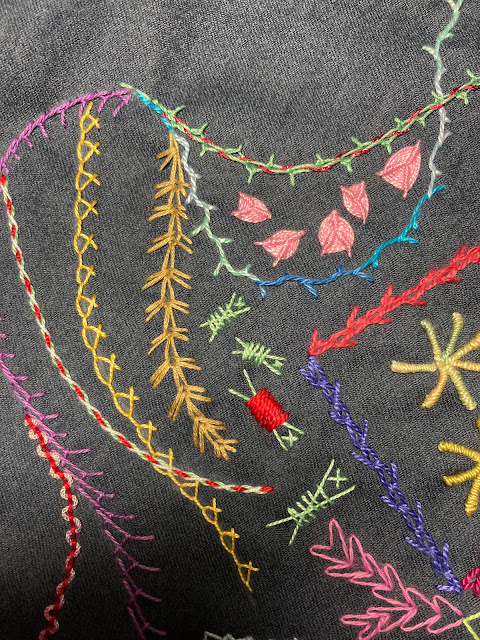
You know the Running Stitch, whip it and you get Whipped Running Stitch, whip it one more time (with the needle going in the opposite direction) and you get today's stitch: Double Whipped Running Stitch.
I found it in A-Z of Embroidery Stitches 2 where it is called Whipped Double Running Stitch. I changed the name as the Whipping is double, not the Running Stitch.
In looks it is very similar to #263 Plaited Fly Stitch or a line of Fly Stitch rubbing shoulders. However, when worked over a folded edge, you can see the difference.
This is one of the first stars I learned to draw as a child - two triangles on top of each other, one upside down. To stitch it, you 'draw' it in a totally different way.
You need only one thread. You make a long stitch and then couch it down on the way back. The coaching part of the stitch is rather wide, so you might not work out how the stitch is made at first glance.
It covers the foundation fabric nicely. You need, however, a good supply of thread in your stash for this hungry stitch. Worked on Aida it looks very neat with tidy edges. In freeform style, it can get a bit shaggy if you are not careful, or if that is your wish.
It's Wednesday so you know it is time for a Work In Progress Wednesday report.
Mandala
I keep stitching a garland of Bouqlé Stitch along the curved border. I haven't come full circle yet, but will hopefully have done so by next week...
Sunday Stitch School Stitch Sampler
Four more stitches were added: #186 Stick People (mint green (one of the stick people has a red dress)), #215 Up and Down Crossed Buttonhole Stitch (yellow), #223 Whipped Fly Stitch Wheel (pink) and #265 Double Whipped Running Stitch (red, white and green).
I haven't had anything to report for a long time but here at last is some progress on Work In Progress Wednesday.
Sunday Stitch School Stitch Sampler
To fill in some of the blank areas on the sampler I put in some extra stitches of previously added ones.
#260 Laced Mountmellick (silver and red, on the left). #265 Double Whipped Running Stitch (green, orange and white) and #298 Hatamusubi (the long line at the bottom, from the left, purple wool, white perle, green wool, orange metallic, beige polyester and finally green polyester (not in the picture)). The thread ends have all been joined on the back using the Hatamusubi knot, or Weavers' Knot or Sheet Bend).
In another void, I added #168 Croatian Stitch (red and blue metallic).
Hexablooms
There are now five more flowers, which brings the total to 100.
The second block of the Green Man quilt is in the style of whole cloth - literally. One piece of fabric, no patches, no appliqué, no embroidery.
Traditionally a whole cloth quilt is usually large, suitable for a bedcover of a single or double bed. One large piece of fabric for the top and one for the back sandwiched with batting in between. The quilt pattern is marked on the top fabric. The layers are basted together, and the quilt is stretched in a quilting hoop or a large quilting frame. Then the quilting can begin. This is usually done with a quilt stitch similar to the Running Stitch. Traditional patterns are feathers, wreaths and cross-hatching.
Amy Emms M.B.E is for sure the most famous whole cloth quilter in the UK. Her work was stunning.
Another decorated quilter famous for her whole cloth quilts is Jacquie Harvey B.M.E., read her story on Costume and Textile Association's website.
Jacquie's way of quilting is unique, she uses no hoop, no thimble and not even the traditional quilting needle. In spite of that, her stitches are minute and the result is impeccable. Furthermore, Jacquie is going her own way by using wax crayons for shading in the design and pays great attention to the edging of her quilts, almost always with whipped piping.
Among the Work In Progress Wednesday projects you will find that an old friend - the Tvistsöm Cushion - is now back in action.
Tvistsöm Cushion
Do you remember the Swedish long armed cross stitch, Tvistsöm, and the cushion I am making in wool?
At the beginning of the pandemic I ran out of yarn and had to shelve the project, because I wanted to avoid using public transport to go to the shop. Finally I have now managed to get to the tapestry wool supplier and have restocked my stash of wool hanks.
I am working on column no 41.
Log Cabin Project
No fewer than 16 seams got the 'Embroidery Treatment'.
I added the following stitches:
Chain,
Portuguese Border,
Buttonholed Double Chain,
Woven Cross,
Raised Cup,
Shell Chain,
Alternating Up and Down Buttonhole,
Knotted Buttonhole Band,
Whipped Running,
Granitos,
French Knotted Chain,
Buttonholed Fly,
E Laced Edging,
Magic Split,
Amadeus,
Brick
The yellow lines indicate where these 16 seams are, the red lines are the previously stitches ones.
10 new log cabin blocks were stitched for the quilt. Total block count: 144
Freeform Embroidery
Linked Chain, Zig-zag Coral and Spanish Feather were added.
Crazy for Crazy
I worked some beads and sequins on the purple block.