Way in the past, when I saw the Japanese Darning Stitch in books, I thought it must be an easy stitch. After giving it a half hearted try once, it turned out all wrong and I abandoned my attempt. That is why I choose this stitch for Sunday Stitch School's tenth lesson. I HAD to master it.
Once I got the hang of the spacing, it was easy-peasy and most enjoyable. I think it would indeed be a decorative darning stitch and fun to add to a Crazy Quilt seam, maybe with other stitches added.
I wanted to explore more, but did not find the time, so here is the set homework :
Chitra of Jizee6687's weblog has some stunning ways of working the Japanese Darning Stitch. Check them out here.
Friday, 3 February 2017
Wednesday, 1 February 2017
Work In Progress Wednesday - The Love Life of Snakes
Trinity Green - the snaky quilt
I don't know anything about the love life of snakes, but when I checked the box they have been hibernating in, there were four new long ones and a baby of 27 triangles!
So for this WIPW report I can tell you I now have a total of 7.047 triangles.
No need to comment on this progress.
I don't know anything about the love life of snakes, but when I checked the box they have been hibernating in, there were four new long ones and a baby of 27 triangles!
So for this WIPW report I can tell you I now have a total of 7.047 triangles.
No need to comment on this progress.
Sunday, 29 January 2017
Sunday Stitch School - Lesson 10: Japanese Darning Stitch
Darning socks, clothes and other textile items was seen as a necessary skill in the past, and samplers were made to show how.
The Japanese stitching crafts of sashiko and kogin were used to reinforce clothing, joining layers together and at the same time embellish what needed to be mended or strengthened. Intricate patterns were created and handed down.
However, the embroidery stitch known as Japanese Darning is a combination of the Running Stitch and the Holbein Stitch and does not feature in the Sashiko or Kogin style.
Or am I wrong? Carorose, Queen of Kogin, is there a connection? Do you know the history of Japanese Darning?
Mattia supplied the French name: Point de trait japonais ou point de reprise japonais, but I have traced no name in Swedish, nor in JAPANESE!!!!!
I found the Japanese Darning Stitch in several of my books, the best illustrations were in The Embroidery Stitch Bible.
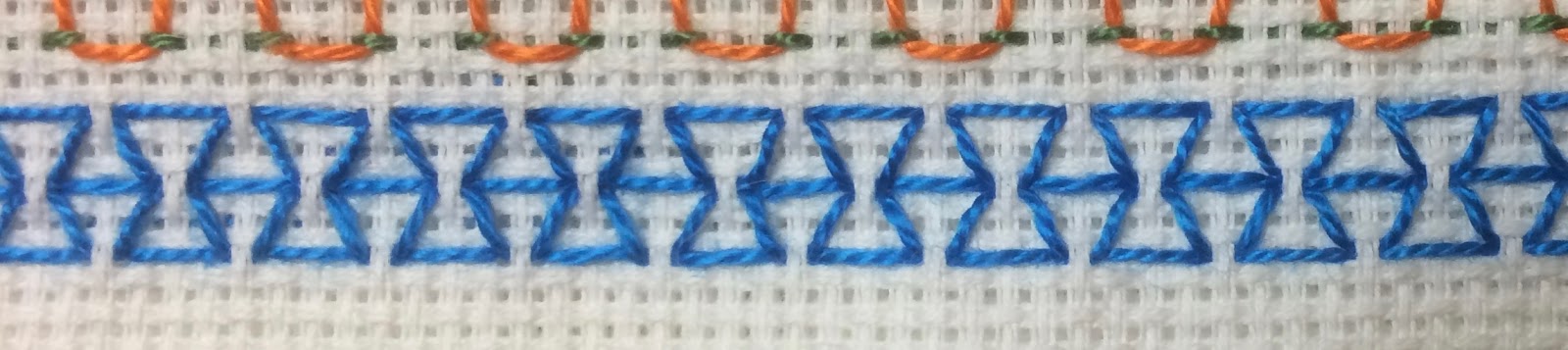
This is what Japanese Darning Stitch looks like on my Aida sampler.

Working order:
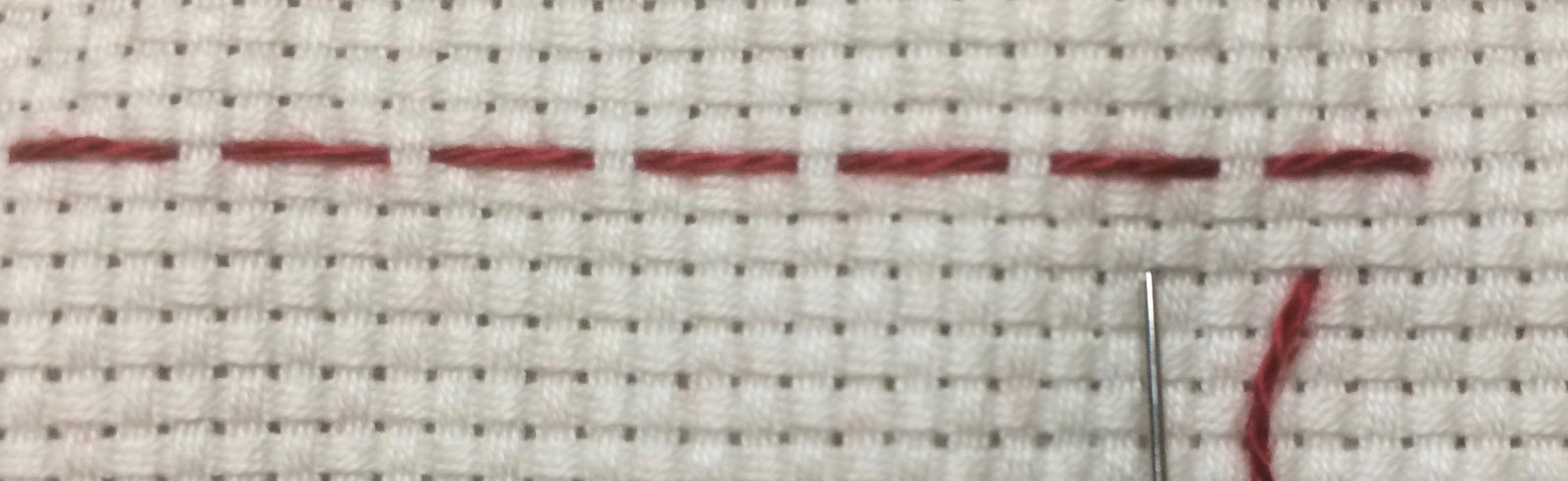
First a row of Running Stitches, longer on the top of the fabric than below and over an odd number of holes.
Then add a second (and third and so on) row where the stitches are placed in a brickwork fashion.
Stitch slanted Straight Stitches to join the rows.
For clarity I have used a different colour.
Continue in the second row.
Happy Stitch Sunday to all!
The Japanese stitching crafts of sashiko and kogin were used to reinforce clothing, joining layers together and at the same time embellish what needed to be mended or strengthened. Intricate patterns were created and handed down.
However, the embroidery stitch known as Japanese Darning is a combination of the Running Stitch and the Holbein Stitch and does not feature in the Sashiko or Kogin style.
Or am I wrong? Carorose, Queen of Kogin, is there a connection? Do you know the history of Japanese Darning?
Mattia supplied the French name: Point de trait japonais ou point de reprise japonais, but I have traced no name in Swedish, nor in JAPANESE!!!!!
I found the Japanese Darning Stitch in several of my books, the best illustrations were in The Embroidery Stitch Bible.
This is what Japanese Darning Stitch looks like on my Aida sampler.

Working order:
First a row of Running Stitches, longer on the top of the fabric than below and over an odd number of holes.
Then add a second (and third and so on) row where the stitches are placed in a brickwork fashion.
Stitch slanted Straight Stitches to join the rows.
For clarity I have used a different colour.
By using two rows you get a zig-zaggy border.
By adding row upon row you can fill a larger area, and
that is the HOMEWORK:
Fill a block on this sampler with Japanese Darning.
Happy Stitch Sunday to all!
Saturday, 28 January 2017
16th Tokyo International Great Quilt Festival 2017 (Wa or Japanese quilts)
'Wa' stands for Japanese and the quilts entered in this category of the contest should have something Japanese, be it fabric, motif or technique.
Wheels of indigo.
By Tsukiei(?) Hanabusa 花房月栄
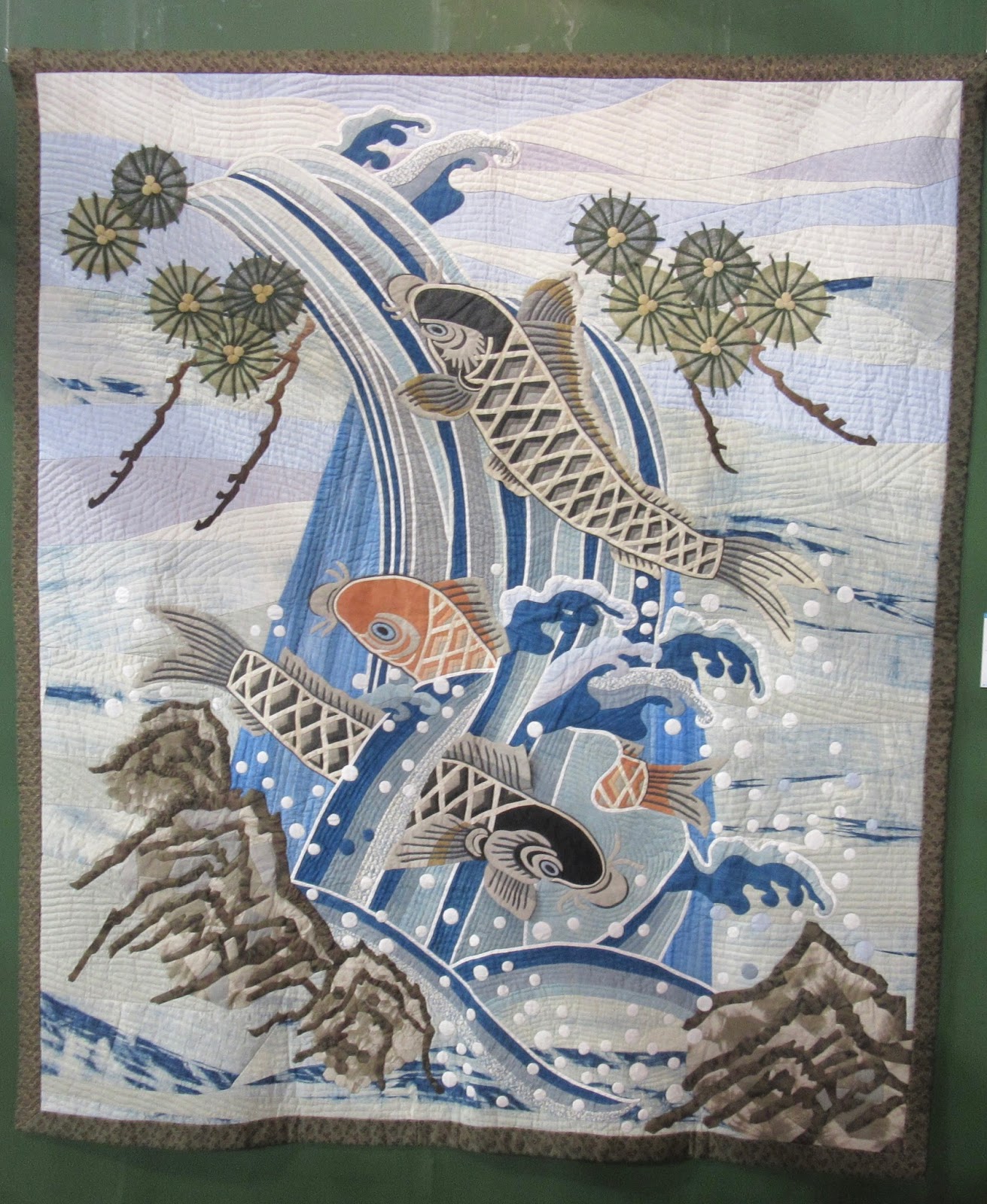
Carps and pine needles
By Yoshiko(?) Uemura 上村義子
You need a good collection of kimono silk to make such gradation in your quilt.
By Michiko Ohbuchi 大淵美智子
Reflections in the quiet pond by an old water mill.
By Kaworu Okada 岡田かをる

The Asian dragon has no wings but can climb the air nevertheless.
By Michiko Kitahara 北原美千子
Wheels of indigo.
By Tsukiei(?) Hanabusa 花房月栄
Carps and pine needles
By Yoshiko(?) Uemura 上村義子
By Michiko Ohbuchi 大淵美智子
Reflections in the quiet pond by an old water mill.
By Kaworu Okada 岡田かをる
Flower viewing by Ayako(?) Sato 佐藤絢子
It is a Western patchwork pattern but the fabric is all shibori kimono silk. Fancy collecting all these shades!The Asian dragon has no wings but can climb the air nevertheless.
By Michiko Kitahara 北原美千子
Subscribe to:
Posts (Atom)